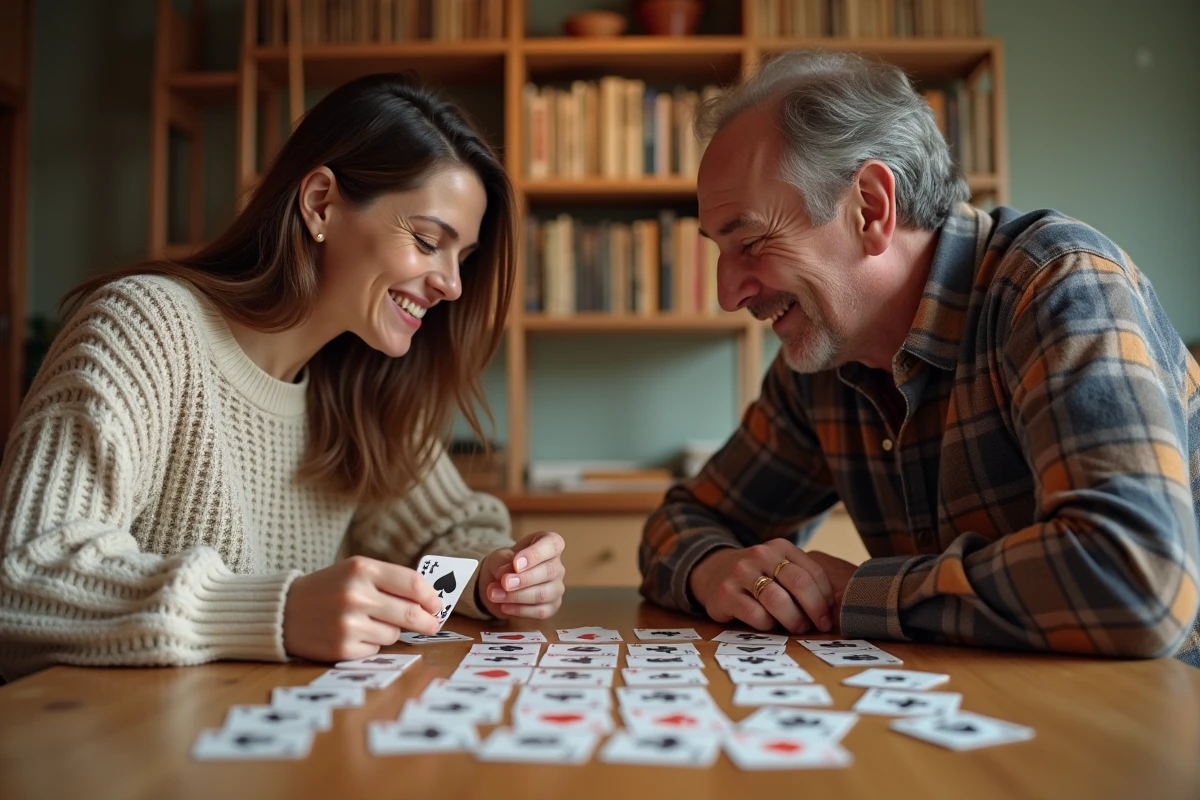
When you bring out the nain jaune board for a couple’s evening, the first instinct is to deal the cards as usual. The problem arises quickly: with only two hands in play, the sequences flow without resistance and the pots remain full for entire rounds. Adapting the mechanics of nain jaune for a duel requires some concrete adjustments to the dealing, betting, and pace of the rounds.
Wider stock and doubled bets: the two adjustments that change everything for 2 players
In the classic setup, each player receives 22 cards and the stock contains only 8. The issue is that almost the entire game is visible. You can roughly guess what the opponent holds, and blockages become rare.
The first adjustment is to reduce the hand to 15 or 16 cards per player. This way, a stock of about twenty cards is reconstituted, which reintroduces uncertainty. No one can guess whether the king of hearts is in the stock or in the opponent’s hand.
The second adjustment concerns the initial bet. In a classic game, you place 1 token on the 10 of diamonds, 2 on the jack of clubs, 3 on the queen of spades, 4 on the king of hearts, and 5 on the 7 of diamonds. With two players, several player communities recommend doubling these bets, or even tripling them on the 7 of diamonds.
The pots grow faster and motivate risk-taking. Adapting the nain jaune rule for 2 players primarily involves these two levers: enlarged stock and increased bets.
Progressive pot in nain jaune: the variant that reignites tension in a duel
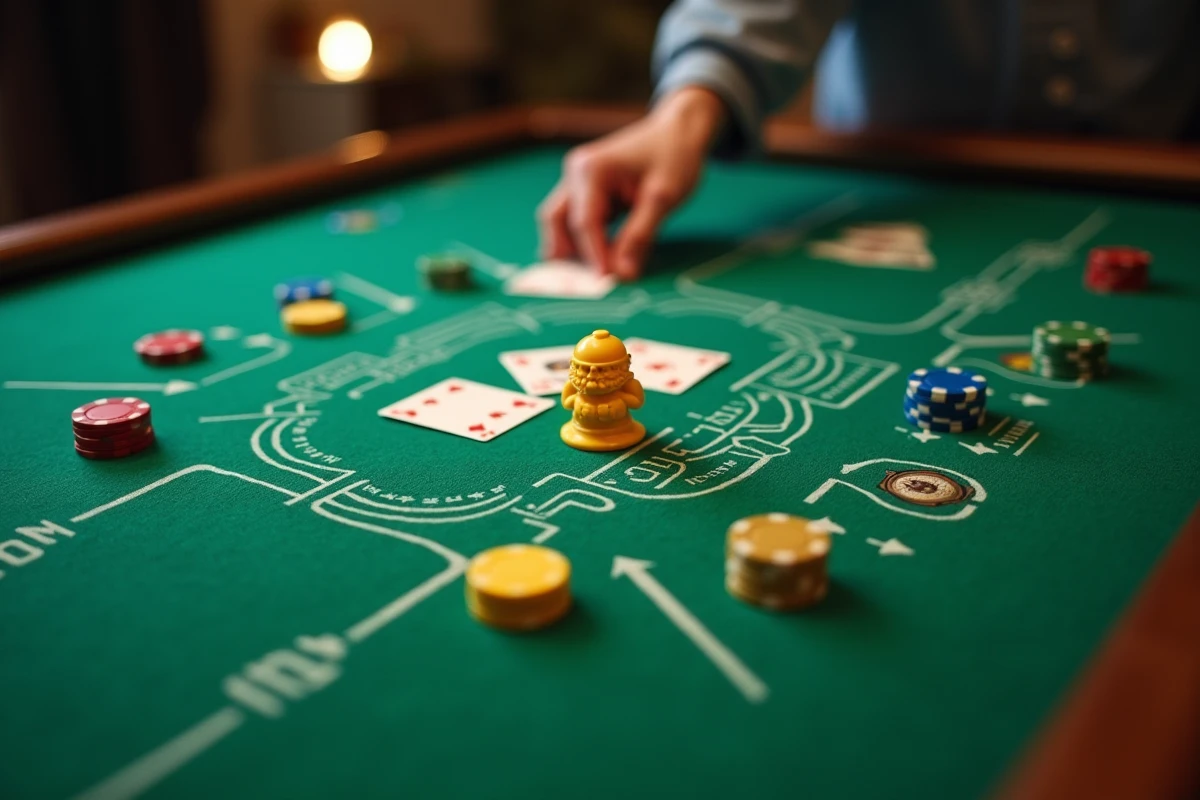
The progressive pot is probably the most effective variant for maintaining interest over several rounds with two players. The principle: when no one claims a pot during a round (because the corresponding card was in the stock, for example), the pot stays in place and adds to the next bet.
After three or four rounds, the nain jaune pot (7 of diamonds) can represent a considerable sum. There is then a real tactical stake: should you play aggressively to empty your hand, or hold back to try to play the 7 of diamonds at the right moment?
This mechanism compensates for the lack of opponents. With four or five players, the competition for pots happens naturally. With two, the progressive pot fills this role by creating increasing pressure with each new round.
Setting up the progressive pot
- Each unclaimed round for a special card automatically doubles its pot in the next round, in addition to the normal bet
- If the 7 of diamonds remains unplayed for three consecutive rounds, it can be agreed that the winner of the next round takes the entire pot, even without having played the 7
- Feedback varies on this point: some players prefer to let the pot grow indefinitely, while others set a cap to prevent a single play from deciding the entire game
Event cards and forced exchange: variants to energize the duel
In recent years, small French publishers have offered optional modules that can be integrated into the classic nain jaune. The idea: to add some “event” cards to the deck to create direct interaction between the two players.
These cards allow for example to force the opponent to show part of their hand, exchange a card with them, or block a discard in progress. In a duel, these actions radically change the dynamic. You move from a game where each player plays their sequences in parallel to a confrontation where every card played can be countered.
These modules are not part of the traditional rules. They can be found in the catalogs of specialized micro-publishers, presented as ways to “boost” interaction when playing with two. If you don’t have these cards, you can improvise a homemade system with simple rules:
- Draw a card from the stock at random once per round and apply a predefined effect (exchange, block, forced draw)
- Allow each player to “freeze” an opponent’s card once per round, preventing its play for a turn
- Permit a voluntary exchange of a card for a card from the stock before the start of each round, adding an extra tactical choice

Nain jaune in short sequences: adapting game duration to duel format
With two players, the rounds end much faster than in the normal setup. You empty your hand in just a few rounds. To avoid the game stretching over twenty monotonous rounds, it is better to set a score objective rather than a number of rounds.
You can agree that the first player to reach a certain total of tokens wins the game. This format gives a more dynamic pace. Every round counts, and managing the tokens becomes a real strategic parameter: you can choose to bet big for a decisive move or play conservatively to steadily accumulate points.
Shorten without impoverishing
The other option is to play in “sprint” rounds: deal only 10 cards per player instead of 15, with a massive stock. The rounds last barely a few minutes, but the uncertainty related to the stock makes every decision more tense. Fewer cards in hand means more surprises in the stock.
This format is well-suited for short breaks or late-night ends when you want a few quick games without committing to a long session.
Nain jaune for two players works as long as you don’t apply the standard rules without adjustments. Enlarged stock, increased bets, progressive pot, or event cards: each adjustment compensates for the absence of other players around the board. The simplest approach is to test one variant per evening and keep the one that best fits your playing pace.