A collectible figurine shipped without care rarely arrives intact. The fragility of appendages (swords, wings, antennas), the sensitivity of the paint to friction, and the sometimes high weight of the resin require a packaging protocol distinct from that of a standard object. Packing a figurine for shipment means solving three simultaneous problems: absorbing shocks, immobilizing the piece in its container, and avoiding any abrasive contact with the painted surfaces.
Specific Fragility of Figurines: What Breaks and Why
The most frequent damage to a shipped figurine is not clean fractures. The 2024 report from insurer Marsh McLennan highlights that claims increasingly focus on value depreciation due to micro-impacts: a detached piece, a chip of paint, a slight curvature of a fine element. For a collector, a figurine with scratched varnish or a re-glued arm loses a significant part of its market value.
Three areas concentrate the majority of damage. Protruding parts (weapons, rigid capes, decorative bases) act as levers that amplify the slightest jolt. Glue joints, especially cyanoacrylate on smooth resin, give way under prolonged vibration. Acrylic paint, even when varnished, marks upon direct contact with newspaper or adhesive tape.
Understanding these weak points changes the logic of packaging. The goal is not simply to “cushion,” but to eliminate any relative movement between the figurine and its container, as detailed in the advice from 100,000 Watts on protecting statuettes for shipping.
Padding and Protective Materials for Painted Figurines
The choice of material for direct contact with the figurine dictates everything else. Acid-free tissue paper is the first line of defense: it protects the paint without scratching it and does not adhere to the varnish. Bubble wrap should only be used as an outer layer, never against the painted surface, as its bubbles can leave circular marks on still-sensitive acrylic.
Building a Cocoon Around Each Piece
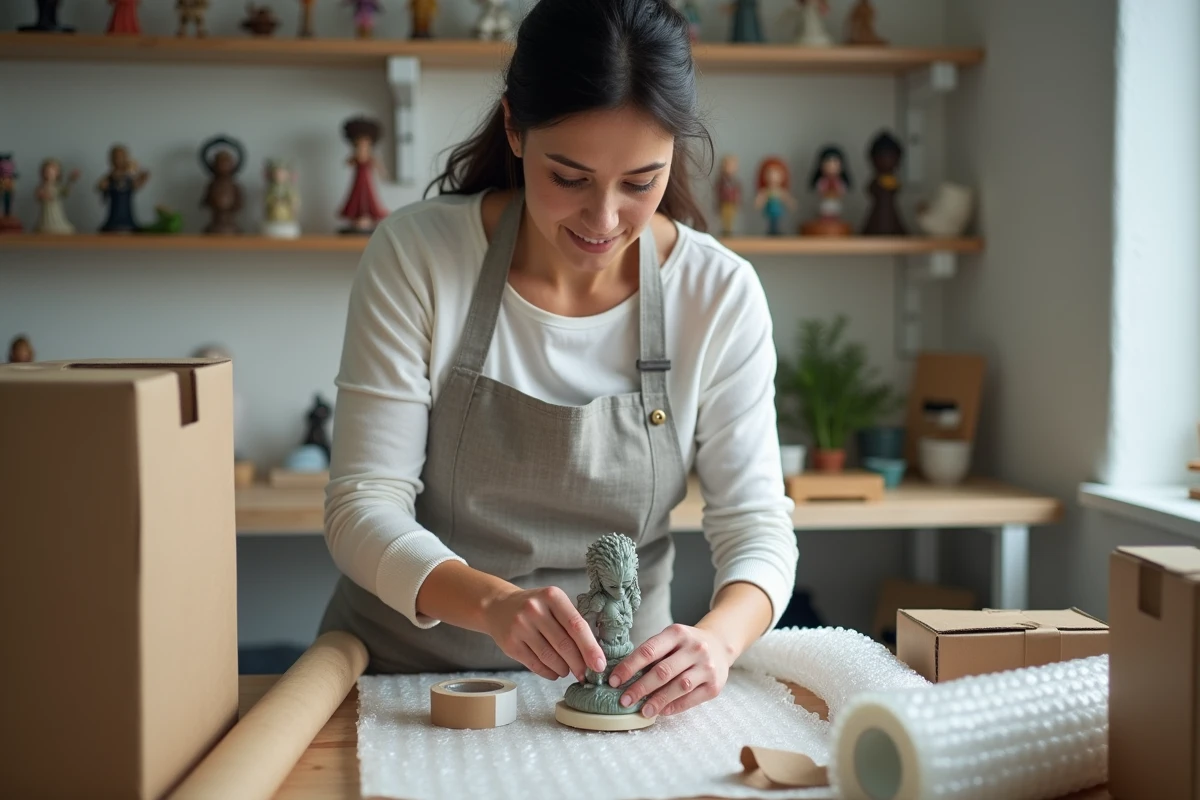
Each figurine must be packed individually, even if several are going in the same package. The method involves first wrapping the piece in two layers of tissue paper, then creating a bubble wrap shell around this first layer. Protruding parts receive separate treatment: a foam sleeve (like cut polyethylene foam) around a sword or spear prevents the mechanical leverage that breaks these elements in transit.
The materials to prioritize depend on the value and fragility of the piece:
- Acid-free tissue paper for direct contact with the paint, in at least two layers to absorb micro-friction.
- Cut polyethylene foam sheets or sleeves to cushion protruding areas and base stands, as it does not collapse under weight.
- Small bubble wrap as an outer layer for shock absorption, never in direct contact with a varnished surface.
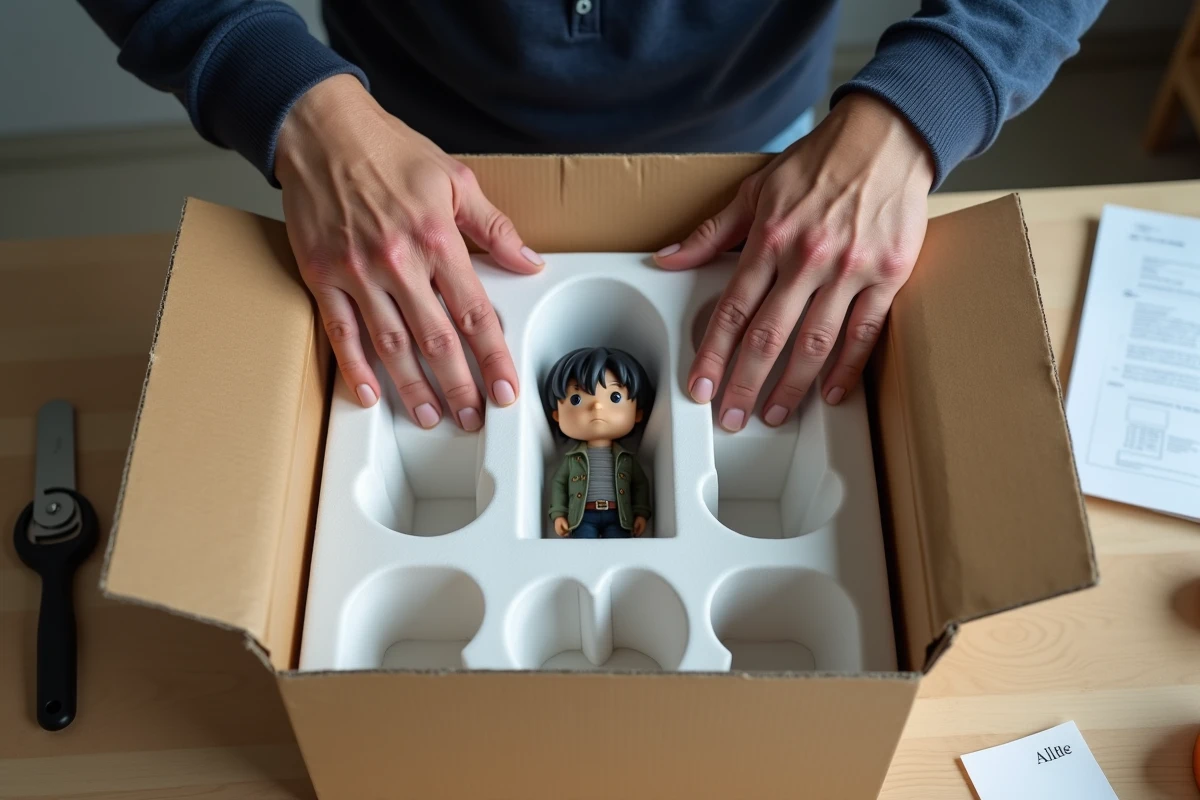
Peripheral padding is as important as direct wrapping. A perfectly packed figurine but free to move in its box will sustain damage. Empty spaces should be filled with crumpled kraft paper cushions or foam, not with polystyrene chips that migrate and leave the piece exposed after a few jolts.
Double Packaging and Choosing the Shipping Box
The principle of double packaging (or “box-in-box”) offers the best protection for collectible figurines. The figurine secured in a first rigid box is placed in a larger shipping box, with at least three centimeters of padding space on each side. This void, filled with cushioning material, acts as a buffer zone that absorbs shocks before they reach the inner box.
Selecting the Appropriate Box
A single-wall cardboard box is sufficient for the inner box. The outer shipping box benefits from being double-walled, especially for resin figurines whose weight puts more stress on the walls. The cardboard must be new or in perfect condition: a reused box with weakened fibers loses a significant part of its crush resistance.
Sealing tape should be applied in an H pattern on both sides of the outer box, meaning along the central opening and then on the two perpendicular seams. A simple strip of tape down the center is the leading cause of accidental opening in transit.

Insurance and Compensation Conditions During Shipping
Proper packing does not exempt one from checking the carrier’s conditions. Colissimo updated its specific conditions in 2024: fragile collectible items are only compensated with proof of compliant packaging, including double packaging and padding on each side. Without this proof, compensation may be reduced.
UPS France applies a similar rule. Its transport conditions (2024 version) explicitly classify “collectibles, antiques, and artwork” as high-risk items. For these categories, the carrier may require photographs of the packaging before shipping in case of a dispute.
Some precautions significantly reduce the risk of disputes:
- Photographing each step of the packaging (bare figurine, after tissue paper, after padding, closed box) to create a proof dossier in case of a claim.
- Taking out additional insurance as soon as the declared value exceeds the carrier’s basic compensation limit.
- Keeping the purchase receipt or a recent valuation to justify the declared amount.
The trend described by Marsh McLennan shows that disputes increasingly focus on depreciation rather than total destruction. A collector receiving a figurine with a part that shifted during transport ends up with a functionally intact but commercially devalued item. Meticulous packaging remains the only reliable defense, as no insurance truly compensates for the loss of a rare piece in perfect condition.